ARMENIA
HomeArmenia
- The land to fall in love with -
The Armenian cognac
It is easier to climb up Mount Ararat than to get out of Ararat Cognac cellar.
- Maxim Gorky
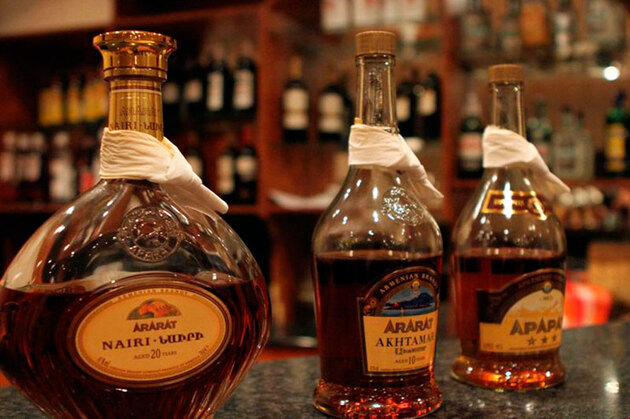
Cognac speaks Armenian!
Armenia is known for many things, but the greatest glory to the country brings the Armenian cognac. Brandy production in Armenia began in 1887 by the...
The Armenian cognac
It is easier to climb up Mount Ararat than to get out of Ararat Cognac cellar.
- Maxim Gorky
Cognac speaks Armenian!
Armenia is known for many things, but the greatest glory to the country brings the Armenian cognac. Brandy production in Armenia began in 1887 by the guild merchant Nerses Tairyan.
Brandy distillation and production process was carried out with French classical technology using which French brandies were being made.
In 1899, Nerses Tairyan sold the factory to Russian merchant Shustov because of aroused trouble connected to transportation of already made goods (at that time there was no railroad in Armenia).
The second phase of Armenian brandy history began in 1899 and was connected to the name of new owner. In order to learn technological nuances, Nikolay Shustov visited one of cognac factories situated in France. Shustovs began to apply the latest technologies and produce an exceptional brand.
In 1900 he sent his beverage samples to an exhibition taken place in Paris, without mentioning producer's name. During the "blind tasting," a group of experts unanimously awarded ''Grand Prix'' to unknown product. It is hard to imagine how amazed they were finding out that the winner was not a French producer. The French attitude was noble France showed a noble attitude; for some period of time, Shustov was allowed to write "cognac" on his bottles instead of "brandy."
After Revolution, Shustov's company was nationalized by the First Republic of Armenia and was renamed ''Ararat Brandy and Wine Factory''. During the meeting of Churcill, Stalin and Franklin Roosevelt taken place in 1945, there was used Armenian cognac and wine.
The legendary Leader of British government Winston Churchill, played a great role in saving his favorite beverage, the Armenian cognac. According to the ''Russian Express Gazette'', the elite beverages of Margar Sedrakyan,who was the Armenian cognac maker and taster, had unprecedented success during diplomatic meetings. Sir Winston Churchill once advised, "Never be late for lunch, smoking Hawaiian cigars and drinking Armenian cognac."
In 1942 Margar Sedrakyan created the unique 50-degrees Dvin brandy which was first introduced in 1943 at a conference taken place in Tehran. It was dedicated to Winston Churchill who was celebrating his 69th birthday. When British prime minister tasted the beverage, he announced that he would drink no other brandy than that.
Until his death (1965), Churchill regularly received 10 cartons (20 bottles each) from the USSR, which he called "divine beverage". Historians claim that at the time when Stalin sent 75 bottles of Dvin to Winston Churchill on his 75th birthday, Churchill was upset that he had not turned 100 already.
Armenian National Flat Bread ''Lavash''
In 2014 “Lavash” was included in intangible cultural heritage of humanity representative list by UNESCO. Lavash is a flat bread made of flour, salt, water and sourdough. In Armenia the usage of Lavash goes back more than three thousand years. During the excavations in the city of Artashat, an oven was discovered in the earth where lavash was being baked. Lawash is a fine, long, oval bread up to 120 cm long. It is made in a special clay cylinder...
Armenian National Flat Bread ''Lavash''
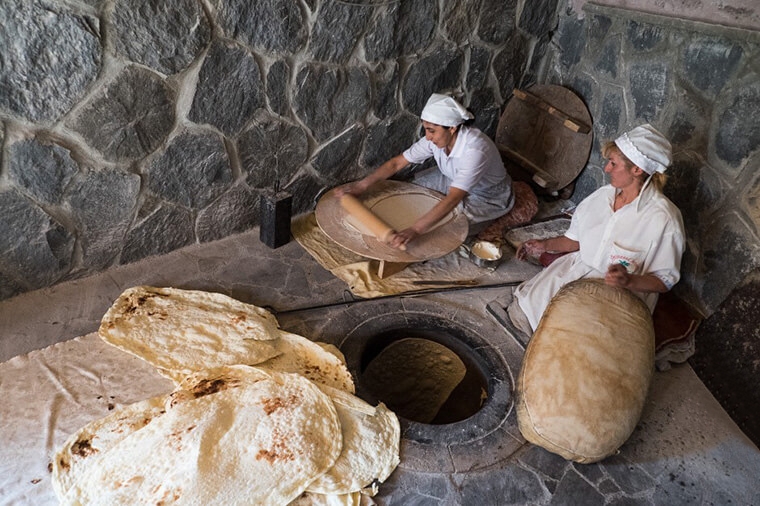
In 2014 “Lavash” was included in intangible cultural heritage of humanity representative list by UNESCO. Lavash is a flat bread made of flour, salt, water and sourdough. In Armenia the usage of Lavash goes back more than three thousand years. During the excavations in the city of Artashat, an oven was discovered in the earth where lavash was being baked. Lawash is a fine, long, oval bread up to 120 cm long. It is made in a special clay cylinder oven buried in the ground: it is called ''tonir''(tandoor).The preparation requires great efforts. Preparation process starts by making small round pieces from the dough. After that the dough is being rolled out on the cushion by using the rolling pin and slapped on the wall of the tonir. After 1-2 minutes, lavash bread is ready and brought out from tonir. Lawash is being dried and can be stored for months. Before eating, the dried bread is being moistened, covered with something warm. After 5-10 minutes it is as fresh and soft as the newly backed one. Lawash is placed on the shoulders of the newlyweds during wedding ceremony as a symbol of fertility and prosperity.
The oldest leather shoe in the world
The cave situated in the border region of Armenia has turned out to be a true treasure of archaeology. The stable, cold and dry atmosphere of the cavern, located in Vayotz Dzor province, made the objects to preserve unusually well over thousands of years. The floor of the cave was covered with a thick layer of sheep dung, which protected objects underneath and contributed to their good preservation. Excavations led by University College Cork's international researchers team...
The oldest leather shoe in the world
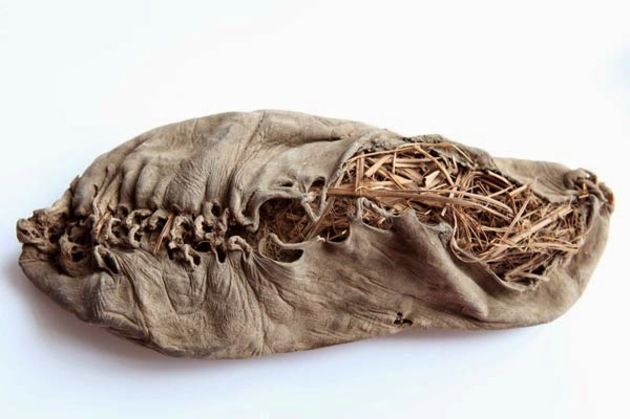
The cave situated in the border region of Armenia has turned out to be a true treasure of archaeology. The stable, cold and dry atmosphere of the cavern, located in Vayotz Dzor province, made the objects to preserve unusually well over thousands of years. The floor of the cave was covered with a thick layer of sheep dung, which protected objects underneath and contributed to their good preservation. Excavations led by University College Cork's international researchers team discovered here findings dating back to Copper Age, the period typical of Europe between the Neolithic and the early Bronze Age.
Leather shoe extremely well preserved
The objects, which are around 5,500 years old, included not only vessels with preserved foodstuff such as wheat and barley, apricots and other edible plants, but also the leather shoe in a perfect form. “Even the laces were preserved”, explains Diana Zardaryan, a researcher from ''Armenian Institute of Archaeology'' and founder of prehistoric footwear.
"We initially thought that the shoe and other objects were only around 600 to 700 years old because they were preserved in a quite good form," adds Ron Pinhasi, the head of excavation from Cork University College of Ireland. "After the material was studied by two radiocarbon laboratories in Oxford and California, we realized that the shoe was even a few hundreds years older than those worn by Ötzi the Iceman."
The shoe, dating back to 3,500 years B.C., is made of single piece of leather that was fitted to the shape of the worn foot. It was stuffed with grass. Archaeologists, however, are not sure whether was this for the profection from cold or for keeping the shoe in shape. "It is not evident whether the shoe belonged to a man or a woman," Pinhasi said. "It coincides with today's European size 37, however in the past it could well fit a man, as well."
Interestingly, the prehistoric shoe with its style is very similar to "pampooties," a type of the shoe being made and worn in Aran Islands of Ireland from 1950 and which is still practical. "Factually, there are enormous similarities between manufacturing technique and style of these shoes to those found throughout Europe, even in later periods. The following facts prove that this type of shoe, from the living conditions' point view, was made and worn for millennials in a large and diverse regions.
Wings of Tatev
Do you know that the longest ropeway in the world is in Armenia?
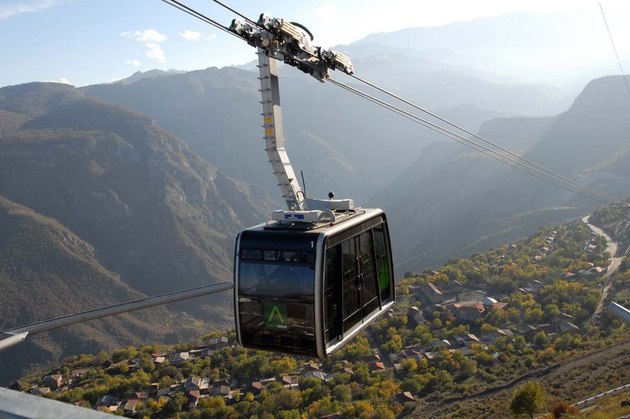
The cable car connects the village of Halidzor, located south of Goris in the province of Syunik being at an altitude of over 1500 m, across two mountain peaks and the Vorotan Gorge, which is 2.7 km wide and about 500 m deep, with the monastery and village of Tatev. At its lowest point, the cable car still hovers 321 m above the gorge. "Wings of Tatev" was built while being a part of "Tatev Revival" project initiated by Ruben Vardanyan and Veronika Zonabend. The official opening of the cable...
Wings of Tatev
Do you know that the longest ropeway in the world is in Armenia?
The cable car connects the village of Halidzor, located south of Goris in the province of Syunik being at an altitude of over 1500 m, across two mountain peaks and the Vorotan Gorge, which is 2.7 km wide and about 500 m deep, with the monastery and village of Tatev. At its lowest point, the cable car still hovers 321 m above the gorge. "Wings of Tatev" was built while being a part of "Tatev Revival" project initiated by Ruben Vardanyan and Veronika Zonabend. The official opening of the cable car took place on October 16, 2010.
On October 23 of the same year, "Tatev" ropeway was registered in the Guinness Book of Records as the longest reversible ropeway in the world. By the way, not only the length of the ropeway (5752 ) is a record, but also the construction period (only 10 month).
The project was implemented by the world's leader in ropeway construction, the Austrian-Swiss company "Doppelmayr / Garaventa".
The Armenian alphabet
The Armenian alphabet is one of the most perfect in the world.
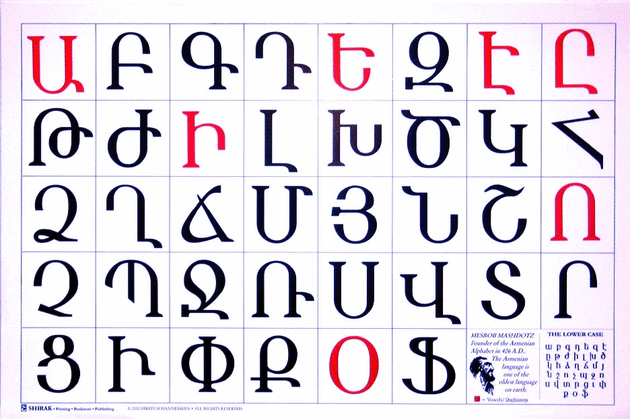
It was created from 405 to 406 by the scholar and Vardapet (archimandrite) Mesrop Mashtots. The base of the writing system was Armenian ancient 28 letters, which did not correspond to the Armenian vocabulary. Mashtots' alphabet consists of 36 letters having 7 vowels and 29 consonants. After the 12th century the alphabet was enriched with two more letters. Moreover, in 1940 there was created one more letter by merging two existing letters. There are upper and lower case letters, as well as script and printed letters. The Armenian...
The Armenian alphabet
The Armenian alphabet is one of the most perfect in the world.
It was created from 405 to 406 by the scholar and Vardapet (archimandrite) Mesrop Mashtots. The base of the writing system was Armenian ancient 28 letters, which did not correspond to the Armenian vocabulary. Mashtots' alphabet consists of 36 letters having 7 vowels and 29 consonants. After the 12th century the alphabet was enriched with two more letters. Moreover, in 1940 there was created one more letter by merging two existing letters. There are upper and lower case letters, as well as script and printed letters. The Armenian script was developed during the time when Armenia was divided between Sassanid Persia and the Roman Empire. In that period of time the country and the people were threatened by annihilation. It was very important for Armenians to fight for their national identity, but without their own script and written language system it would be very difficult. The letters developed by Mesrop became 36 soldiers that guarded the identity of people. After the creation of alphabet, there were opened schools in the country where the Armenian language was taught. The existing script writing system was not only from top to bottom but also from right to left. Now only from right to left system is used.
Scientists consider the Armenian alphabet to be one of three most perfect alphabets in the world, along with Georgian and Korean alphabets.
There is an opinion that Mesrop Mashtots also created Georgian and Albanian alphabets.
For more than six hundred years the Armenian alphabet has kept its existance almost unchanged. The monument to the creator of the Armenian alphabet, Mesrop Mashtots, is located in front of the Museum of Ancient Manuscripts ''Matenadaran'' situated in Yerevan.
The first arithmetic textbook in the world was written by an Armenian mathematician
The textbook of the world's first arithmetic problems was written by David Anhaght, Armenian scientist of the 6th century. According to Mesrop Mashtots, the copy of this textbook is kept in "Matenadaran Institute of Ancient Manuscripts". The "Matenadaran" is one of the largest repositories of ancient manuscripts in the world. In Matenadaran there are also kept other ancient, not only Armenian but also foreign manuscripts.
The importance of chess in Armenia
Chess is a popular game for Armenians
In Armenia, chess has been known since early Middle Ages, but gained wide recognition in the Soviet Union times. It is one of the most popular games in the country. Chess in Armenia became popular in 1960s when Tigran Petrosyan took chess world champion title. With a population of about three million people, Armenia is considered to be one of the strongest chess playing countries...
The importance of chess in Armenia
Chess is a popular game for Armenians
In Armenia, chess has been known since early Middle Ages, but gained wide recognition in the Soviet Union times. It is one of the most popular games in the country. Chess in Armenia became popular in 1960s when Tigran Petrosyan took chess world champion title. With a population of about three million people, Armenia is considered to be one of the strongest chess playing countries in the world. Armenia is one of the countries having the biggest number of grandmasters.
The Armenian men's chess team won European Championship (1999), World Championship (2011) and Chess Olympiad (2006, 2008, 2012). The women's team won the European Championship in 2003. As of September 2015, Armenia is ranked seventh in the Elo average rating in top ten chess players in the world. As of September 2015, Armenia's highest-ranked chess player, Levon Aronian, occupied 11th place in the FIDE rankings.
Chess has been a compulsory subject in Armenian secondary schools since 2011-2012. Gary Kasparov compared the popularity of chess in Armenia to the popularity of soccer in Latin America.

The pomegranate as a symbol for Armenians!
Pomegranate has been unique and rich symbol since ancient times. According to ancient Greeks, pomegranates were grown by the god of vegetation, sponsor of viticulture and winemaking Dionysius, the symbol of the tree of life of Phoenicians. Pomegranate as a symbol of fertility and purity is one of three sacred fruits of Buddhism, along with citrus and peaches. Pomegranate was given to Greek goddess of love and beauty Aphrodite, as well as to the goddess of motherhood and agriculture Hera. Pomegranates...
The pomegranate as a symbol for Armenians!
Pomegranate has been unique and rich symbol since ancient times. According to ancient Greeks, pomegranates were grown by the god of vegetation, sponsor of viticulture and winemaking Dionysius, the symbol of the tree of life of Phoenicians. Pomegranate as a symbol of fertility and purity is one of three sacred fruits of Buddhism, along with citrus and peaches. Pomegranate was given to Greek goddess of love and beauty Aphrodite, as well as to the goddess of motherhood and agriculture Hera. Pomegranates are considered to be a forbidden fruit of paradise in Scandinavian folk tradition. The pomegranate is a symbol of fertility, abundance, generosity and purity. The pomegranate was also considered to be a sign of power because of the crown on its head, and a large number of fruits embedded in the thick bark symbolizing the universe with planets and stars.
The symbolism of pomegranates is very popular in Christianity. It is a symbol of our Lord Jesus Christ, whose blood was poured into the chalice, and in visual arts the Lord was depicted with a pomegranate, expressing the idea of Christ's resurrection.
The pomegranate, both in its symbolic sense and as a national ornament, was widely used in Armenian architecture, carpets, in other types of applied art, and in miniature, as of illustrated by Grigor Khlatetsi, Toros Taronatsi, Toros Roslin, and others.
Pomegranates, in the interpretation of Armenian Church, are considered to be words of prophets who, like a parable cover the bouquet of sweetness with their thick and bitter skin. There is an opinion that in ancient times the old royal crown shape idea was taken from the pomegranate crown.

Duduk
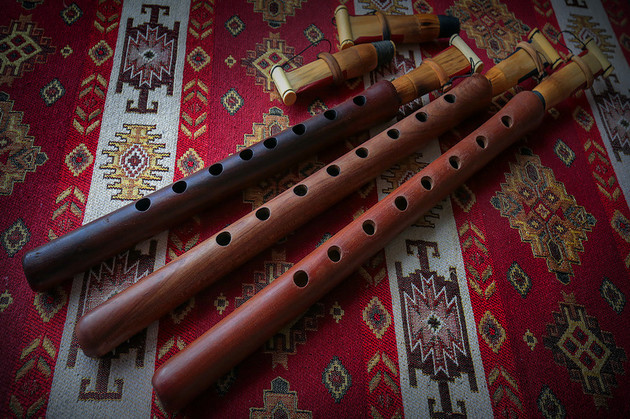
Duduk is Armenian musical instrument made of wood which have 9 holes.
The traditional name of duduk is Tsiranapogh (apricot wind instrument). Armenian duduk is made of special kind of apricot tree that grows only in Armenia.
In the beginning, duduk was considered to be male instrument, that is why it was played exclusively by men. However, nowadays women are also...
Duduk
Duduk is Armenian musical instrument made of wood which have 9 holes.
The traditional name of duduk is Tsiranapogh (apricot wind instrument). Armenian duduk is made of special kind of apricot tree that grows only in Armenia.
In the beginning, duduk was considered to be male instrument, that is why it was played exclusively by men. However, nowadays women are also interested in it.
There is a social stereotype that this musical instrument can only sound with sad motives. However, it is far from reality. Duduks are often played during festive ceremonies. Moreover, the instrument has become a "participant" in musical genres such as jazz, blues, pop, classical music and even rock.
Armenian duduk is considered to be UNESCO Intangible World Heritage Masterpiece.
The motherland of apricots
Apricots have been growing in Armenia for over 3,000 years. The evidence are apricot seeds founded during excavations done near Garni Temple. In Latin, apricots are called "Prúnus armeniáca". Apricot is one of the symbols of Armenia which occupies a special place in the national culture. Already in the 3rd millennium BC the Akkadians called the fruit "Armanu" (i.e. "Armenian"), and the land Armenia- Armani. The ancient inhabitants of Mesopotamia, the Arameans (Chaldeans), called the apricot tree "khazura Armenaya"- Armenian apple.
One of the previous Arabic names for apricots is "tufah al armani", which again means Armenian apple...
The motherland of apricots
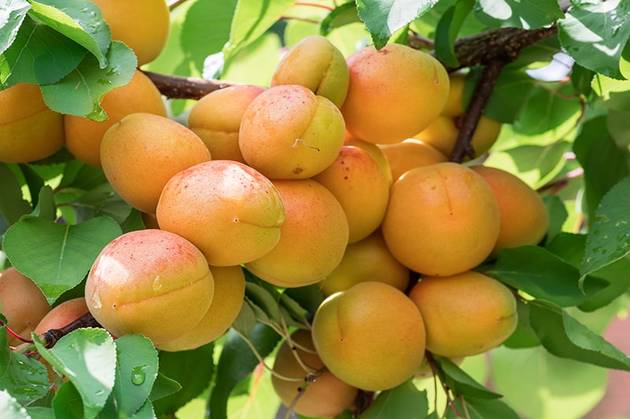
Apricots have been growing in Armenia for over 3,000 years. The evidence are apricot seeds founded during excavations done near Garni Temple. In Latin, apricots are called "Prúnus armeniáca". Apricot is one of the symbols of Armenia which occupies a special place in the national culture. Already in the 3rd millennium BC the Akkadians called the fruit "Armanu" (i.e. "Armenian"), and the land Armenia- Armani. The ancient inhabitants of Mesopotamia, the Arameans (Chaldeans), called the apricot tree "khazura Armenaya"- Armenian apple.
One of the previous Arabic names for apricots is "tufah al armani", which again means Armenian apple.
In the 1st century BC, the Roman general Lucios Lukullos, while returning Rome from the invasions of Armenia, against the Armenian king Tigran the Great, took apricot seedlings and cultivated in his motherland by naming them “Armenian plums”. Apricots penetrated to European countries and travelled to Greece and Rome via seedlings brought from Armenia.
The famous French biologist De Poerderlé wrote in 18th century, "The name of this tree comes from Armenia, the Asiatic province where it was originated and was brought to Europe"
Apricot growing centers today include China and Central Asia.
Apricot contains carotene and a number of vitamins that are very useful for human body. This fruit refreshes and strengthens people physically and increases workability.
The popular Armenian musical instrument duduk which is made of apricot tree, is also called “Tsiranapogh” that is “apricot-made wind instrument”.
Apricot jam is a medicine for armenians.
The viticulture of the Armenian highlands
The peculiarity of Armenian wine is that you feel what you cannot express in words.
- Charles Aznavour
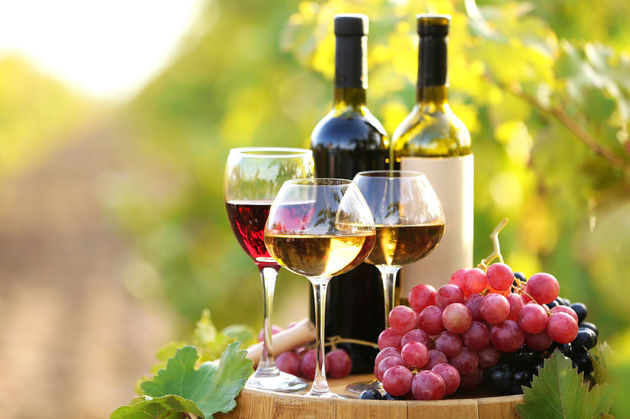
Viticulture in Armenian highlands has been developed for a long time. According to famous Bible story, Armenia is home for viticulture and winemaking. Biblical legend tells that mankind discovered the taste of wine when Noah after the flood planted the first vine at...
The viticulture of the Armenian highlands
The peculiarity of Armenian wine is that you feel what you cannot express in words.
- Charles Aznavour
Viticulture in Armenian highlands has been developed for a long time. According to famous Bible story, Armenia is home for viticulture and winemaking. Biblical legend tells that mankind discovered the taste of wine when Noah after the flood planted the first vine at the foot of Mount Ararat.
According to Bible, the secret of winemaking was revealed with the help of Noah’s goat, which because of drunkenness caused by eating the wild fruit, began to push other animals.
During pagan times there was a tradition in Armenia to make a chrism from different plants. In the first century a man named Pargev, the relative of Armenian king Trdat, learned how to distill alcohol from the plants' juices. In 66 A.D., Trdat along with royal troops and gifts , as well as myron (chrism), routed to the Roman emperor Nero for being coronated. Roman historians announce that while tasting the myron Nero started to be filled with joyfulness.
Scientists have discovered ancient Armenian wineries, wine vessels and pots, carbonated grapes, numerous wedge-shaped inscriptions, sculptures and other documents found throughout Armenia. All these shows that winemaking in Armenia has about 6000 years' history.
The Old Testament tells that Noah planted his first vine while descending Ararat. The researches and archaeological excavations of the scientists assume that Armenians harvested and cultivated grapes in the 6th and 5th millennium BC.
The works of Greek historian Herodotus and philosopher Strabo attest to the development of winemaking in Armenia.
The excavations of 1939 done by Russian archaeologist Boris Piotrovsky in the Urartian fortress of Teishebaini (7th century B.C.) uncovered a wine cellar and about 500 clay barrels. In Erebuni fortress, as well, which was built 2800 years ago, wine warehouses were found.
Moreover, there were found some medieval winery centers near Noravank. During Areni Cave excavations done in 2011, the oldest winery in the world was discovered, which dates back to 6000 years.
The wine is stored in oak barrels as before, but in many villages the wine is stored in clay pots - and barrels. According to experts, Armenian oak enriches wine with the tastes of natural vanilla, chocolate and dried fruits due to its pink hue, creating a unique wine bundle.
Currently, there are 5 viticultural regions in Armenia where endemic grape varieties are grown on a total area of 17,000. From here is obtained high-quality wine and brandy. Armenian wine is exported to the former Soviet countries, also to USA and Europe.
Areni Wine Festival
In Vayots Dzor Province, in the village of Areni,every year, usually in autumn, there are organized wine festivals. During the festival, participants enjoy the best wines of the village. The festival begins with a parade of best winemakers and is being continued with many other events: public and professional wine tasting, exhibition of traditional dishes of country’s best restaurants, music, dances, games, theater performances and programs with the participation of popular artists.
Artsakh (Nagorno-Karabakh) Wine Festival
The first Artsakh wine festival was held on October 18, 2014 in the village of Togh of Hadrut region. The aim of the festival was to promote tourism and wine production in Artsakh.
The festival program included ancient and unique winemaking rituals, starting from wine squeezing, traditional Artsakh dishes, art exhibitions, exhibitions of archaeological findings in Togh, and exhibitions of 5 wine producers from Artsakh and Armenia.
Yerevan is one of the oldest cities in the world
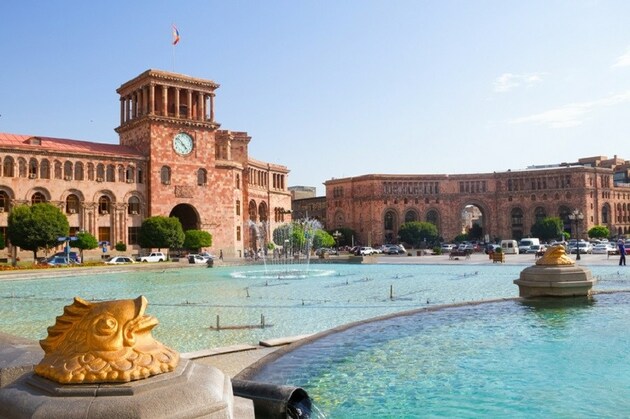
The 13th capital of Armenia, Yerevan, is one of the oldest cities in the world and is located in the northeastern part of Ararat Valley. The city was built in 782. BC by the Urartian king Argishti I. The history of Yerevan is equal to the epochs of Babylon, Rome, Carthage and Samarkand. Moreover, Yerevan is 29 years older than Rome. In 2018, the city celebrated its 2800th anniversary.
What do the archaeologists say? It turns out that in 1950, during the excavations of Arinberd hill (situated in the southeastern part of Yerevan), they managed to discover the "birth certificate" of the...
Yerevan is one of the oldest cities in the world
The 13th capital of Armenia, Yerevan, is one of the oldest cities in the world and is located in the northeastern part of Ararat Valley. The city was built in 782. BC by the Urartian king Argishti I. The history of Yerevan is equal to the epochs of Babylon, Rome, Carthage and Samarkand. Moreover, Yerevan is 29 years older than Rome. In 2018, the city celebrated its 2800th anniversary.
What do the archaeologists say? It turns out that in 1950, during the excavations of Arinberd hill (situated in the southeastern part of Yerevan), they managed to discover the "birth certificate" of the city of Yerevan, carved in cuneiform on a basalt stone.
The inscription reads:
"For the glory of the god Chaldi, Argishti, the son of Menua built this mighty fortress, gave it the name Erebuni for the power of the land of Biaini and for the invasion prevention of hostile countries".
The immense and impregnable Erebuni Fortress was the largest strategic citadel of the northern borders of the State of Urartu for that period. It had a large military garrison and was surrounded by massive fortress walls, which were laid out in triplicate. In the fortress there were the palace for the king Argishti I with large columns and wide halls, the walls of which were covered with rich murals of cultic and secular purposes, temples, one of which was dedicated to the supreme god Chaldi, grain stores, a water conduit and other buildings. During excavations, a large number of bronze and iron tools, earthenware, weapons and jewelry, as well as artifacts of Urartian masters were found. The findings testify to a wonderful building technique and a highly developed economy of the Urartians.
Today, you can admire all the findings in the museum of "Erebuni".
The Armenian people adopted not only the rich culture, but also the architectural and construction traditions of Urartians. Today's architectural ensemble of Yerevan gives to the city very unique character and style.
Yerevan is included, as it were, in the grandiose panorama of the Ararat valley, crowned with the cone of Great Ararat and Less Ararat. The Great Ararat is especially admirable in early mornings, when it is illuminated with the golden shimmering rays of the sun.
The eminent Armenian architect Alexander Tamanyan and his students created the unique external shape of the city. Multicolored stone in all its splendor is prevailed in the architecture of Yerevan.
If architecture is the face of the city, museums are its soul. Yerevan has a large number of museums, monuments and parks with unique sculptures and individual memorials.
The Armenian capital has made a great progress since the end of the Soviet era. Instead of dreariness, there is a spirit of optimism.
Today, especially during warm months, the city becomes a bustling place from morning to late nights. A boom has exploded in Armenia's metropolis in the last fifteen years or so. Yerevan, sad and mysterious city at the foots of eternally snow-covered Ararat, has shed its skin. One café next to another, committed to the international style of comfortable wicker furniture, and waiters everywhere elegantly balancing their trays between the tables.
Here are gathered all the colors of the rainbow: from purple, pink and orange, reddish and white tufa stone. From gray basalt there have been built homes, public buildings, churches, theaters and museums.
The first official church in the world
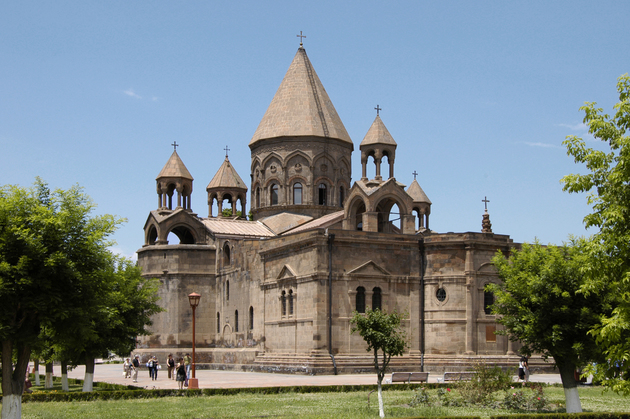
Mother See of Holy Etchmiadzin is the first official church built in IV century.
It is an Armenian Apostolic Church situated in Armavir province. It is a part of monastic complex and cathedral of Patriarch of Armenian Apostolic Church, the Catholicos of Mother See of Holy Etchmiadzin and All Armenians.
The church building has been erected starting from 301 at the behest of the first Catholicos Gregory the Illuminator over the bases of the pagan temple. The new building with a wooden roof was erected in 480s, and a forerunner of the present central building was built on its site...
The first official church in the world
Mother See of Holy Etchmiadzin is the first official church built in IV century.
It is an Armenian Apostolic Church situated in Armavir province. It is a part of monastic complex and cathedral of Patriarch of Armenian Apostolic Church, the Catholicos of Mother See of Holy Etchmiadzin and All Armenians.
The church building has been erected starting from 301 at the behest of the first Catholicos Gregory the Illuminator over the bases of the pagan temple. The new building with a wooden roof was erected in 480s, and a forerunner of the present central building was built on its site in early 7th century. The church, which was thoroughly restored in the 17th century, has been listed as a UNESCO World Heritage Site since 2000. In the cathedral there is a museum where relics and treasures are exhibited. The Spear of Christ (the Spear of Longin), with which the Roman warrior Longin wounded Jesus Christ, is kept in the treasury of Mother Cathedral of Holy Etchmiadzin.
The cathedral of Echmiadzin, which is located about 20 km west from Yerevan, is considered to be the oldest Christian site of Armenians and represents the religious center of the country. It is considered to be the first Christian church built by a state and was the oldest church on Soviet Union territory during its time. The cathedral is one of the most significant architectural monuments in Armenia.
According to legend, the first Catholicos Gregory the Illuminator sees in his dream that Jesus Christ descends from the sky with a fire hammer in his hand and strikes to the place where the cathedral should be built. Exactly in that place, the cathedral named Echmiadzin was built. Echmiadzin means «Indigenous descendant».